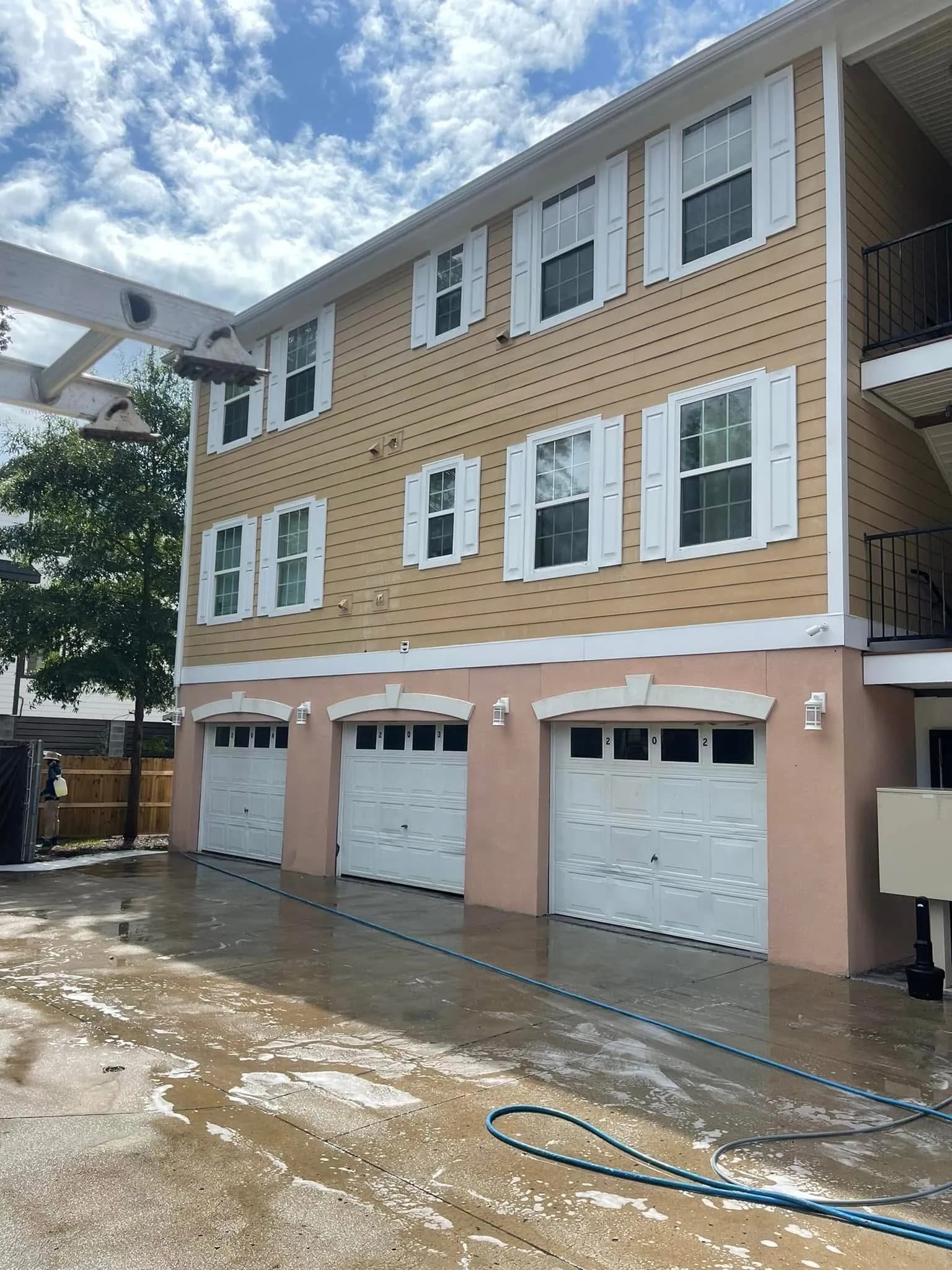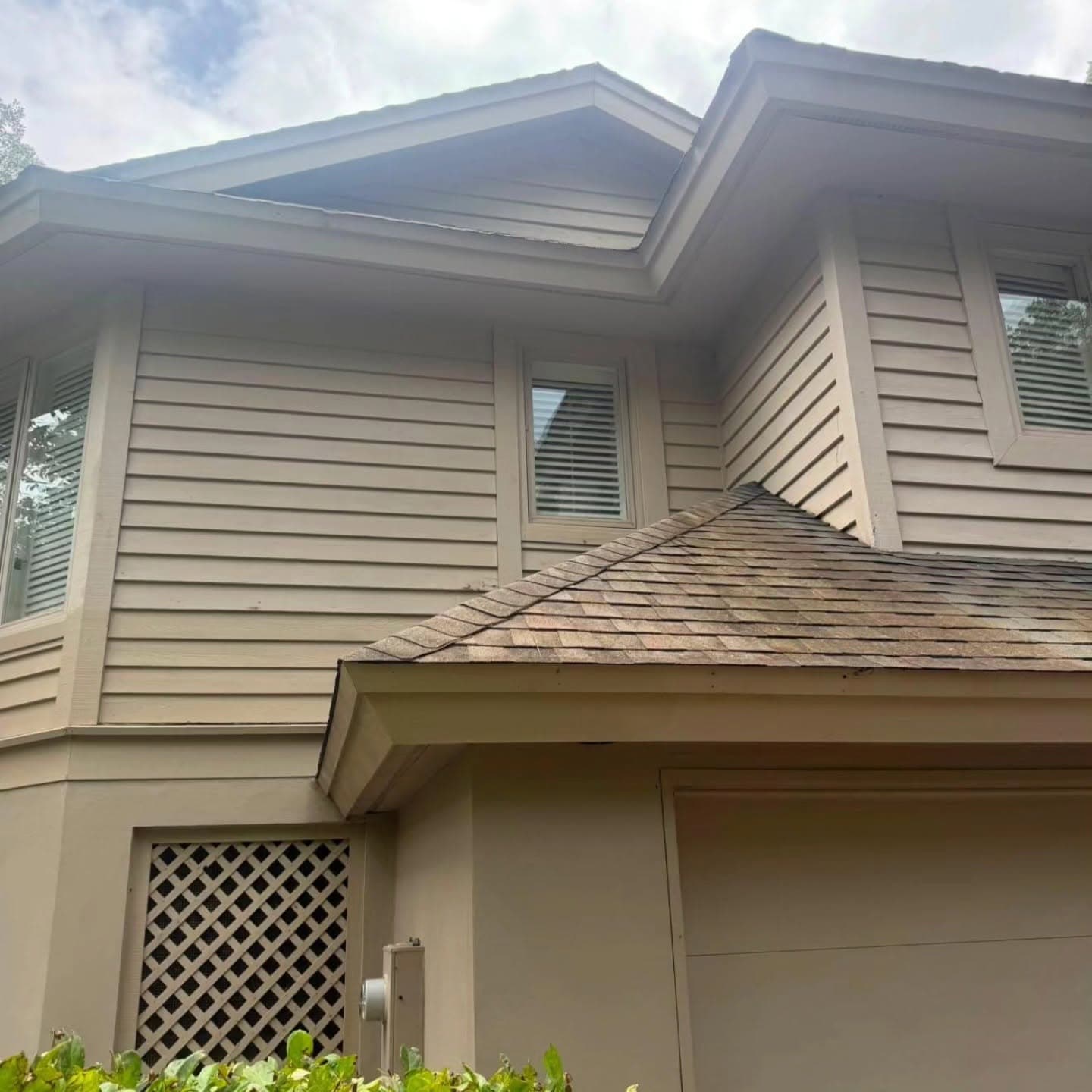
If you have spent any time around pressure washing, you have heard the letters SH tossed around like everyone already knows what they mean. Here is the short version: SH stands for sodium hypochlorite, the same active ingredient in household bleach and pool chlorine, and it is the chemical that does the real work in soft washing. This is the plain English, beginner friendly guide we wish every homeowner had before they bought their first jug of it.
We are Pepper's Pressure Washing and Window Cleaning, and we have soft washed homes across Johns Island, Kiawah, Seabrook, and greater Charleston since 2014. Everything below is how we actually mix and apply SH in the field, written for someone picking it up for the first time. You will learn what SH is, what to mix with it, how much to use on siding versus a roof, the dilution math, the gear that changes your strength, and the safety rules that keep you and your landscaping out of the emergency room.
What is SH in pressure washing?
SH stands for sodium hypochlorite. It is the active ingredient in bleach and pool chlorine, and in pressure washing it is the main cleaner used for soft washing. Instead of blasting grime off with high pressure, SH kills the algae, mildew, mold, and bacteria that stain siding and roofs at the root, so the growth does not just get rinsed away, it dies.
That distinction is the whole point of soft washing. A pressure washer moves water fast enough to knock the visible layer off a surface, but the living organisms behind most exterior staining in the Lowcountry live down in the pores of your siding, shingles, and concrete. Rinse them and they grow back in weeks. Kill them with SH and the surface stays clean for months, sometimes years. If you want the full comparison, we cover it in soft wash versus pressure wash for a roof.
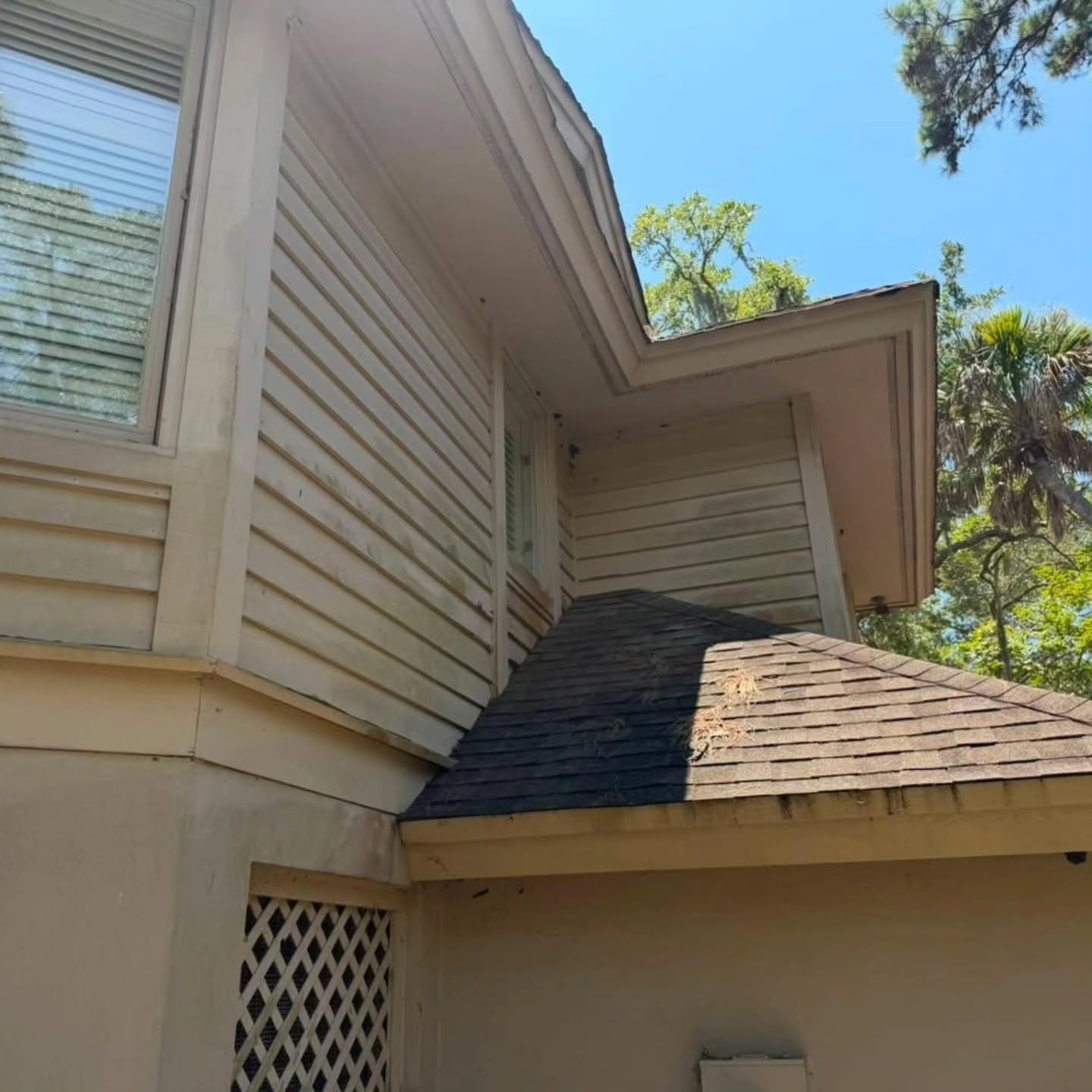
SH vs bleach vs chlorine vs pool shock
SH, liquid bleach, and liquid pool chlorine are all the same chemical: sodium hypochlorite. The only real difference is strength. Household bleach is weak, around 5 to 6 percent. The SH that pros buy is the same molecule at about 10 to 12.5 percent, so it works faster and you use less of it to reach the same result.
Product | Typical strength | Notes |
|---|---|---|
Household bleach | about 5 to 8 percent | Varies by brand and has been creeping up. Clorox Performance Bleach is now 7.55 percent, from 6.05 percent before. Read your bottle. |
Commercial SH | about 10 percent | Sold at pressure washing and pool supply shops. |
Pool shock (liquid) / SH | about 12.5 percent | The pro soft wash standard. Same molecule as bleach, just stronger. |
Before you copy any ratio, read the percentage on your own bottle. Household bleach strengths are not fixed and have drifted upward. Clorox Performance Bleach with CLOROMAX is now 7.55 percent, up from 6.05 percent in the previous formula, while many store brands and pre mixed house washes sit closer to 5 percent. Every mix ratio you will find online, including the ones in this guide, assumes a starting strength. If you assume 6 percent and your jug is actually 7.55 percent, your solution lands about 25 percent stronger than you intended, which matters most on plants and delicate surfaces.
One quick warning. Liquid pool chlorine and liquid chlorine are sodium hypochlorite and are fine to use. Granular pool shock is usually calcium hypochlorite, a different chemical that does not dissolve as cleanly for soft washing. When people say SH, they mean the liquid. If you want the underlying chemistry, the NIH PubChem record for sodium hypochlorite is the canonical reference.
How SH actually cleans
SH cleans by oxidation. It releases active chlorine that breaks down the cell walls of algae, mold, mildew, and bacteria, killing the colony and lifting the staining it caused. It is not a soap that scrubs dirt loose, it is a biocide that ends the living growth causing the stain. That is why a proper soft wash lasts so much longer than a plain rinse.
Here is SH at a glance, the numbers we come back to all through this guide:
Quick fact | Rule of thumb |
|---|---|
Pro strength | about 10 to 12.5 percent |
Household bleach | about 5 to 8 percent, check the label |
Siding target on surface | about 0.5 to 1.5 percent |
Roof target on surface | about 2 to 4 percent |
Dwell time | 5 to 15 minutes, kept wet |
Working pressure | rinse level, under about 500 PSI |
Shelf life | loses strength in about 28 days |
What SH will not clean
SH kills things that are alive. That is its whole job, and it is why it fails completely on stains that were never biological. Exterior cleaning really comes down to four chemistry families, and picking the wrong one wastes an afternoon.
Chemistry family | What it handles | What it will not touch |
|---|---|---|
Chlorine (sodium hypochlorite) | Living growth: black roof streaks, green mildew, algae, moss. Works in minutes. | Rust, oil, efflorescence, oxidation, road film. Harms plants and some metals. |
Oxygen bleach (sodium percarbonate) | Gray weathering and general soil. Safe on wood and fabric. | Heavy algae, which it clears far more slowly than chlorine if at all. |
Quaternary ammonium (quats) | Slow kill over weeks with no rinsing. Used in no rinse roof treatments. | Any same day visible result. This is a patience product. |
Acids (oxalic, phosphoric) | Rust, efflorescence, calcium and mineral staining. | Organic growth. An acid will not kill algae. |
So if your problem is orange sprinkler staining or an oil drip, no amount of SH will fix it, and we cover the right approach in removing rust and oil stains from concrete. If your siding looks chalky rather than green, that is oxidation of the vinyl itself, not growth, and cleaning improves it only so far.
What you mix with SH: water and surfactant
You mix SH with two things: water to bring it down to a safe working strength, and a surfactant, also called a soft wash soap, to help it cling. Water controls how strong the solution is. Surfactant makes it stick to vertical siding and sloped roofs long enough to work instead of running straight off onto the ground.
Surfactant matters more than beginners expect. Plain SH beads up and sheets off a wall before it can kill anything. A surfactant breaks the surface tension so the mix hangs on, dwells, and does its job. It matters even more on vertical siding than on a flatter roof. A common dose is about 1 percent of your total solution, which works out to roughly 6 to 8 ounces per 5 gallons of mixed solution.
The soft wash soaps you will actually see for sale include Elemonator (a lemon scented surfactant that also masks the bleach smell), Slo Mo (an ultra thick soap that extends dwell time), and similar cling additives. They are an addition to SH, not a replacement for it. The SH still does the killing.
The master SH mix ratio table
Here is the part everyone comes for. The table below shows the target strength on the surface for each job, the ratio to mix from 12.5 percent SH, the rough equivalent from 6 percent household bleach, and how much surfactant to add. Remember the golden rule: soft washing is defined by the strength that reaches the surface, not the strength in the jug.
Surface | Target on surface | From 12.5% SH | From 6% bleach | Surfactant |
|---|---|---|---|---|
Vinyl or Hardie siding | 0.5 to 1.5 percent | 1 part SH to 9 to 12 parts water | about 1 to 1 | about 1 percent |
Asphalt shingle roof | 2 to 4 percent | about 1 part SH to 3 parts water | 50/50 (1 to 1) | about 1 percent |
Heavy moss or deep algae | 4 to 6 percent | 1 part SH to 1 or 2 parts water | strong or straight | about 1 percent |
Concrete or driveway | 1 to 3 percent | 1 part SH to 4 to 12 parts water | 1 to 1 or stronger | optional |
Wood or painted (gentle) | 0.5 to 1 percent | 1 part SH to 12 to 24 parts water | well diluted | about 1 percent |
Start low and test first. Every one of those numbers is a starting range, not a fixed recipe. Real results shift with the surface, how heavy the staining is, how fresh your SH is, and the temperature. Mix on the low end, test a small hidden spot, and step the strength up only if you need to. For roofs specifically, follow the roof soft washing approach, and for green concrete see concrete cleaning.
Dilution math made simple
The formula is short. Your applied strength equals your stock strength times the SH portion of the mix. To hit a target, multiply your batch size by the target percent, then divide by your stock percent to get the gallons of SH. Everything else is water.
applied % = stock % x (gallons of SH / total gallons)House wash example. A 5 gallon batch at 1 percent from 12.5 percent SH: 5 times 1 divided by 12.5 equals 0.4 gallons of SH. Add water up to 5 gallons, so about 4.6 gallons of water, plus roughly 6 ounces of surfactant. That is close to a 1 to 11 ratio.
Roof example. A 50 gallon batch at 3 percent from 12.5 percent SH: 50 times 3 divided by 12.5 equals 12 gallons of SH and 38 gallons of water, plus about a half gallon of surfactant. That is close to 1 to 3.
If mental math is not your thing, the calculator below does it for you.
Soft wash mix calculator
Set your SH stock strength, pick a target, and enter your batch size. The calculator returns how much SH, water, and surfactant to mix, plus the ratio it lands. There is a reverse mode too, so you can enter a ratio and see the strength it produces on the surface.
Free tool
Soft wash mix calculator
0.4
gal SH (51 oz)
4.6
gal water
6.4
oz surfactant
1 : 11.5
SH to water
Mix about 0.4 gallons of 12.5% SH with 4.6 gallons of water and roughly 6.4 oz of surfactant to make 5 gallons at 1% on the surface.
Already have a ratio? Check its strength
These numbers are starting points, not a guarantee. Real results depend on the surface, how heavy the staining is, product freshness, and temperature. Always test a small, hidden area first and step up strength only if you need to. Wear eye and skin protection, pre wet and rinse plants, and never mix SH with any acid or ammonia product.
How much SH by job
The right strength depends entirely on what you are cleaning. Delicate surfaces want a lean mix, tough organic growth wants more. Here is the surface by surface breakdown.
House siding
For vinyl, Hardie, painted, or stucco siding, aim for about 0.5 to 1.5 percent SH on the surface with a surfactant. That is roughly 1 part 12.5 percent SH to 9 to 12 parts water. North facing and shaded walls with heavy green growth trend toward the high end. If your siding has stubborn black mold, our guide to removing black mold from vinyl siding walks through it, and our full guide to cleaning vinyl siding covers the cleaner options and the method start to finish.
Asphalt shingle roofs
Shingle roofs need more punch, about 2 to 4 percent on the surface, and up to 5 to 6 percent for heavy moss and gloeocapsa. Apply at rinse level pressure only. The asphalt roofing industry is explicit that you should never power wash shingles because it blasts off the protective granules and can void the warranty. The Asphalt Roofing Manufacturers Association bulletin on roof algae is the authority here, and it is why we only soft wash roofs. If you are dealing with thick moss or lichen rather than flat streaks, the treatment differs, and we cover that in how to remove moss and algae from a roof.
Concrete and driveways
Concrete tolerates a wider range, about 1 to 3 percent, because it is hard and porous. SH kills the algae living in the pores so the green does not come right back after a rinse. For the full story on why Lowcountry driveways turn green so fast, read why your driveway turns green, and for the service itself see driveway cleaning. Worth knowing what SH cannot do here: it will not touch rust or oil, which need completely different chemistry, and we cover that in removing rust and oil stains from concrete. On a paver patio the joint sand changes the approach too, which we cover in how to clean pavers.
Wood, decks, and painted surfaces
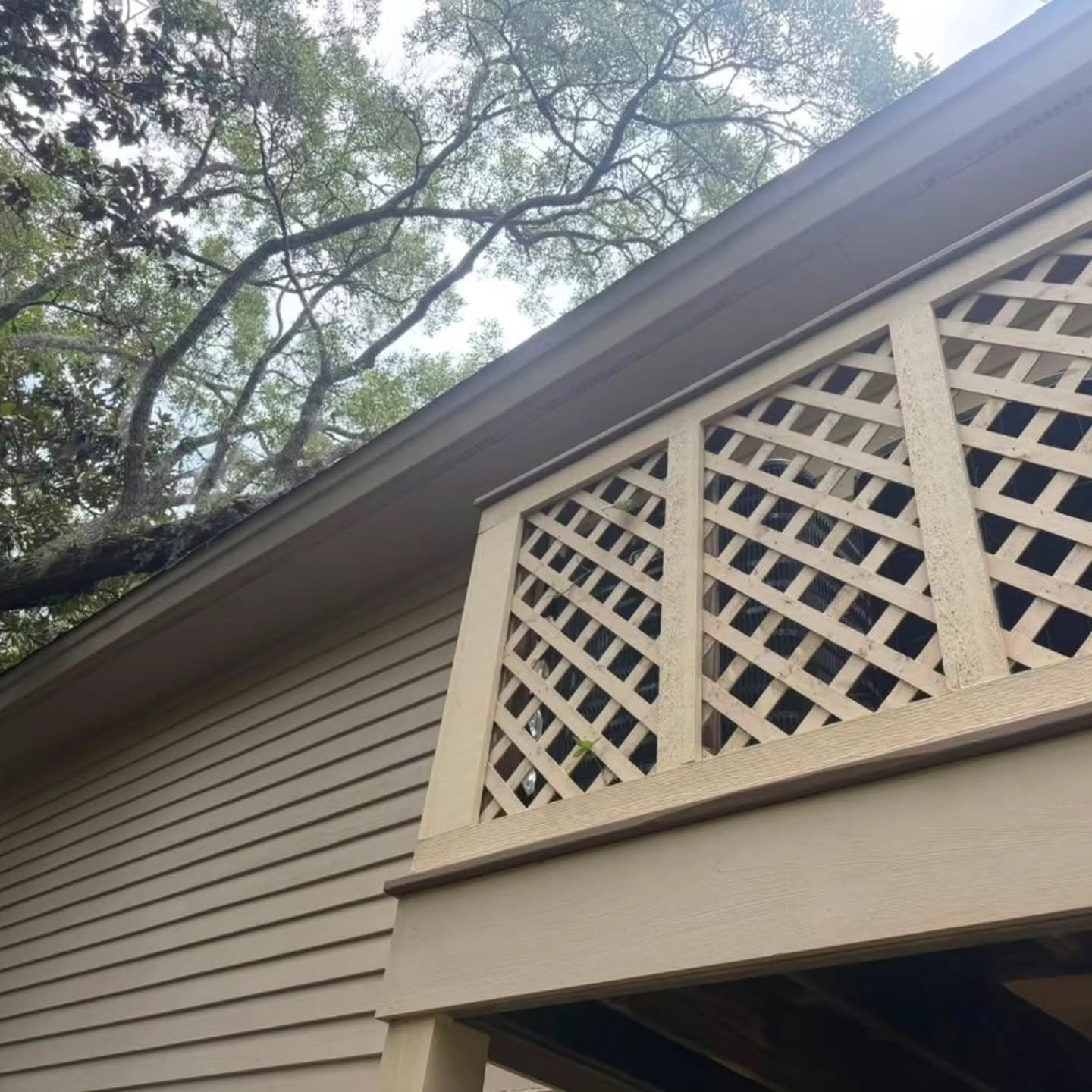
Go gentle here, about 0.5 to 1 percent, well diluted, with a surfactant and a careful rinse. High pressure destroys wood and strips paint, which is exactly why low pressure soft washing exists. The clean white lattice below was soft washed at low pressure without a single gouge.
Equipment: downstream injector vs 12V vs pump sprayer
The machine you use changes how strong your mix lands on the surface, and this trips up almost every beginner. A downstream injector dilutes SH through your pressure washer down to about 1 to 1.25 percent, which is perfect for a house wash but too weak for a roof. A 12 volt system sprays near full strength at low pressure, which is what roofs and heavy jobs need. A pump sprayer applies exactly what you mix.
Method | How it works | Strength it lands | Best for |
|---|---|---|---|
Downstream injector | Draws SH from a tank after the pump and blends it into the water stream at about a 10 to 1 draw. | about 1 to 1.25 percent | House and general exterior washing. The right choice for most jobs. |
12V soft wash system | A low pressure pump sprays mixed solution at or near full strength through a gun. | up to about 12.5 percent | Roofs and heavy jobs that need high SH and long reach without high pressure. |
Pump or backpack sprayer | You spray a pre mixed batch by hand, no pump blending. | exactly what you mix | Small areas, spot treating, and true beginners. |
Here is the part that surprises people. Because a downstream injector only draws about 1 part SH to 10 parts water, even a full strength 12.5 percent jug in the tank lands around 1 to 1.25 percent on the wall. That is plenty for siding, but it physically cannot reach the 3 to 6 percent a mossy roof needs. That is the whole reason roof crews run 12 volt systems.
The tip on the end of the wand matters just as much as the chemistry, because it decides how much force actually lands on the surface. Our pressure washer nozzle chart and safe PSI guide covers which tip to use on every surface and the pressure each one can take.
How to mix and apply with a pump sprayer
The simplest beginner method is a pump or battery sprayer and a pre mixed batch, no injector or rig required. Here is the safe way to do it, start to finish.
Gear up and protect the area. Put on chemical resistant gloves and eye protection. Pre wet all nearby plants, grass, and soil until they are saturated, and keep them wet the whole time.
Mix your batch. Add water to the tank first, then your measured SH, then about 1 percent surfactant. For siding, aim for roughly 1 percent on the surface.
Apply low and work up. Spray onto the surface from the bottom up at low pressure so the mix clings and sheets evenly instead of running and streaking.
Let it dwell. Keep the surface visibly wet for 5 to 15 minutes so the SH can kill the growth. Re apply if it starts to dry.
Rinse gently. Rinse from the top down with low pressure, keeping the landscaping wet as you go.
Flush the landscaping. Give beds, grass, and soil a deep final rinse so no concentrated runoff is left behind.
Dwell time and rinsing
Let SH dwell 5 to 15 minutes, and up to 15 to 20 minutes on a shingle roof, keeping the surface visibly wet the entire time. Then rinse gently from the top down at low pressure. Never let the solution dry on the surface, because it can streak and clean unevenly, and it is far more likely to burn plants.
Soft washing works at rinse level pressure, well under about 500 PSI at the surface, which is softer than many garden hose nozzles. The chemistry does the cleaning, the water only rinses. High pressure on siding drives water behind the boards, on wood it gouges, and on shingles it blasts off the granules that protect your roof. That is not our opinion, it is the manufacturers' position.
Safety: the non-negotiables
SH is bleach at a strong concentration, so treat it with respect. The single most important rule: never mix SH with any acid or ammonia product. Bleach plus ammonia makes chloramine gas, and bleach plus acid, including vinegar, muriatic or pool acid, and many toilet bowl and lime scale cleaners, makes chlorine gas. Both attack your eyes and lungs and can cause life threatening damage hours later.
This is not a theoretical risk. The CDC chlorine fact sheet and Washington State health guidance on mixing bleach both document real poisonings from exactly this mistake. When in doubt, use SH by itself with water and a soft wash surfactant, nothing else.
Do | Do not |
|---|---|
Work outdoors with airflow | Mix SH with ammonia (chloramine gas) |
Wear goggles and chemical gloves | Mix SH with any acid (chlorine gas) |
Pre wet and rinse all landscaping | Power wash shingles or wood |
Keep the surface wet while it dwells | Let the solution dry on the surface |
Use fresh product and follow the label | Store SH near acids, ammonia, or metal |
SH is corrosive and can cause permanent eye damage and skin burns at working strength, so goggles, chemical resistant gloves, long sleeves, and closed boots are not optional. The New Jersey right to know fact sheet on sodium hypochlorite is a good one page hazard summary. And because bleach used to kill algae is a regulated pesticide, keep the labeled container and follow it, as the EPA and NPIC antimicrobials guidance explains.
Protecting plants and landscaping
SH kills vegetation on contact at wash strength, and in the Lowcountry that means your azaleas, camellias, and lawn are all at risk. Pre wet every plant, the grass, and the soil to saturation before you spray, keep them wet through the whole job, and give a deep final rinse. Bag or divert downspouts, watch leaf undersides for delayed burn that can appear a day or two later, and never let concentrated runoff reach a storm drain, the marsh, or a waterway. Pros neutralize runoff with sodium thiosulfate.
Storing SH so it does not go weak
SH is unstable and loses strength over time, which is the number one reason a correct ratio underperforms. A 12.5 percent jug can lose around 20 percent of its strength in about 28 days at room temperature, and heat speeds it up sharply. Buy fresh from a high turnover supplier, use it within a few weeks, and store it cool, dark, sealed, and out of the sun. In a Charleston summer, expect older stock to run weak, so mix a little stronger or replace it.
Troubleshooting a soft wash that is not working
If your soft wash is not cleaning, it is almost always one of a few things, and none of them mean you need more pressure.
The SH is old and weak. Fresh SH is the fix more often than a stronger mix. Heat and time both sap it.
The mix is too lean. Step up toward the top of the range for that surface, one small increase at a time.
It dried too fast. In Charleston heat SH can flash off before it works. Work in shade, on a cooler part of the day, and keep the surface wet.
You skipped the surfactant. Without cling, the mix runs off before it can kill anything, especially on siding.
The green came back in weeks. That is a rinse, not a kill. The SH did not stay on long enough or was too weak.
When to call a pro, and why it is cheaper than a mistake
SH is powerful, and the two most expensive mistakes, a burned lawn and a stripped roof, both happen fast and cannot be undone. If you are working above one story, cleaning a shingle roof, or standing over mature landscaping, it is usually cheaper and safer to hire a licensed and insured pro than to gamble your roof warranty or your azaleas on a first attempt.
We have soft washed homes across Kiawah Island, Seabrook Island, Johns Island, and greater Charleston for over a decade, fully insured, with a re clean guarantee. You can see the work in our gallery, read our customer reviews, or learn how we work. If you are vetting anyone, our guide on how to choose a pressure washing company lists the exact questions to ask. Trade groups like the Pressure Washing Resource Association and the UAMCC are where trained contractors learn this craft.
Frequently asked questions
What does SH stand for in pressure washing?
SH stands for sodium hypochlorite, the active ingredient in bleach and pool chlorine. Pros use it as the main cleaner for soft washing because it kills the algae, mildew, and mold that stain siding and roofs at the root, not just on the surface.
Is sodium hypochlorite the same as bleach?
Yes, chemically. Household bleach is sodium hypochlorite at roughly 5 to 8 percent depending on brand, and strengths have crept up (Clorox Performance Bleach is now 7.55 percent, from 6.05 percent). The SH pros buy is the same molecule at about 10 to 12.5 percent. Always read the percentage on your own bottle before copying a mix ratio.
What is the mix ratio of SH for a house wash?
For most vinyl or Hardie siding, aim for roughly 0.5 to 1.5 percent SH on the surface. From 12.5 percent stock that is about 1 part SH to 9 to 12 parts water, plus a surfactant. Start on the low end and step up only if the staining is heavy.
What mix should I use to soft wash a roof?
Asphalt shingle roofs usually need about 2 to 4 percent SH on the surface, up to 5 to 6 percent for heavy moss. That is roughly 1 part 12.5 percent SH to 3 parts water with a surfactant. Keep pressure at rinse level and never power wash shingles.
How do you dilute 12.5% sodium hypochlorite?
Multiply your batch size by your target percent, then divide by 12.5 to get the gallons of SH. The rest is water. For example, 5 gallons at 1 percent is 5 times 1 divided by 12.5, which is 0.4 gallons of SH and 4.6 gallons of water.
How long do you let SH dwell before rinsing?
Usually 5 to 15 minutes, and up to 15 to 20 minutes on a shingle roof. Keep the surface visibly wet the whole time and never let the solution dry, or you can get streaks and a weaker clean.
Does soft washing kill plants, and how do I protect them?
SH can burn plants at wash strength. Pre wet all plants, grass, and soil before you start, keep them wet while you work, bag downspouts, and give a deep final rinse. Watch for delayed leaf burn that can show up a day or two later.
How long does sodium hypochlorite last?
It fades fast. A 12.5 percent jug can lose about 20 percent of its strength in a month at room temperature, and heat speeds that up. Buy fresh from a high turnover supplier and store it cool, dark, sealed, and away from sunlight.
The bottom line
SH is simple once you understand it: it is strong bleach, water controls the strength, surfactant makes it cling, and low pressure keeps everything safe. Start lean, test a hidden spot, keep the surface wet, protect your plants, and never mix it with anything but water and soap. Do that and you can clean like a pro.
And if you would rather leave the SH, the ladders, and the landscaping risk to someone who does this every day, we are a free quote away.