IPE deck cleaning is its own service category at Peppers, separate from our standard pressure washing line, because the wood requires a fundamentally different approach. The crews that show up to wash a vinyl-sided house in Goose Creek are not the same crews you want anywhere near the IPE you put on the south face of a Kiawah Beach home. Different chemistry, different PSI, different tip selection, different dwell time. A homeowner who calls a generic pressure washing outfit and asks for deck cleaning usually gets a 2,500 PSI rinse-and-go that destroys the surface. We treat IPE the way the wood actually needs to be treated.
Our IPE-Specific Cleaning Process: Low Pressure, High Expertise
Every IPE deck cleaning visit follows the same six-step sequence. We never deviate from it because the cost of getting it wrong is sanding the entire deck. First: a walk-through to identify any boards that have already been damaged by prior cleanings or that need replacement before we proceed. Second: oxygenated cleaner application. We use sodium percarbonate-based cleaners specifically formulated for tropical hardwoods, never chlorine bleach (chlorine darkens IPE permanently and damages the deck screws). Third: dwell time of 8 to 15 minutes depending on UV gray severity. Fourth: rinse at maximum 400 PSI with a 40-degree tip held at least 18 inches off the board surface. We calibrate every tip before use and never exceed this threshold. Fifth: brightener pass to neutralize the cleaner's pH and restore the wood's original color. Sixth: soft-bristle hand scrub on any stubborn salt or pollen residue near rail connections.
Charleston Sun and Salt Air Turn IPE Gray. We Bring the Rich Brown Back
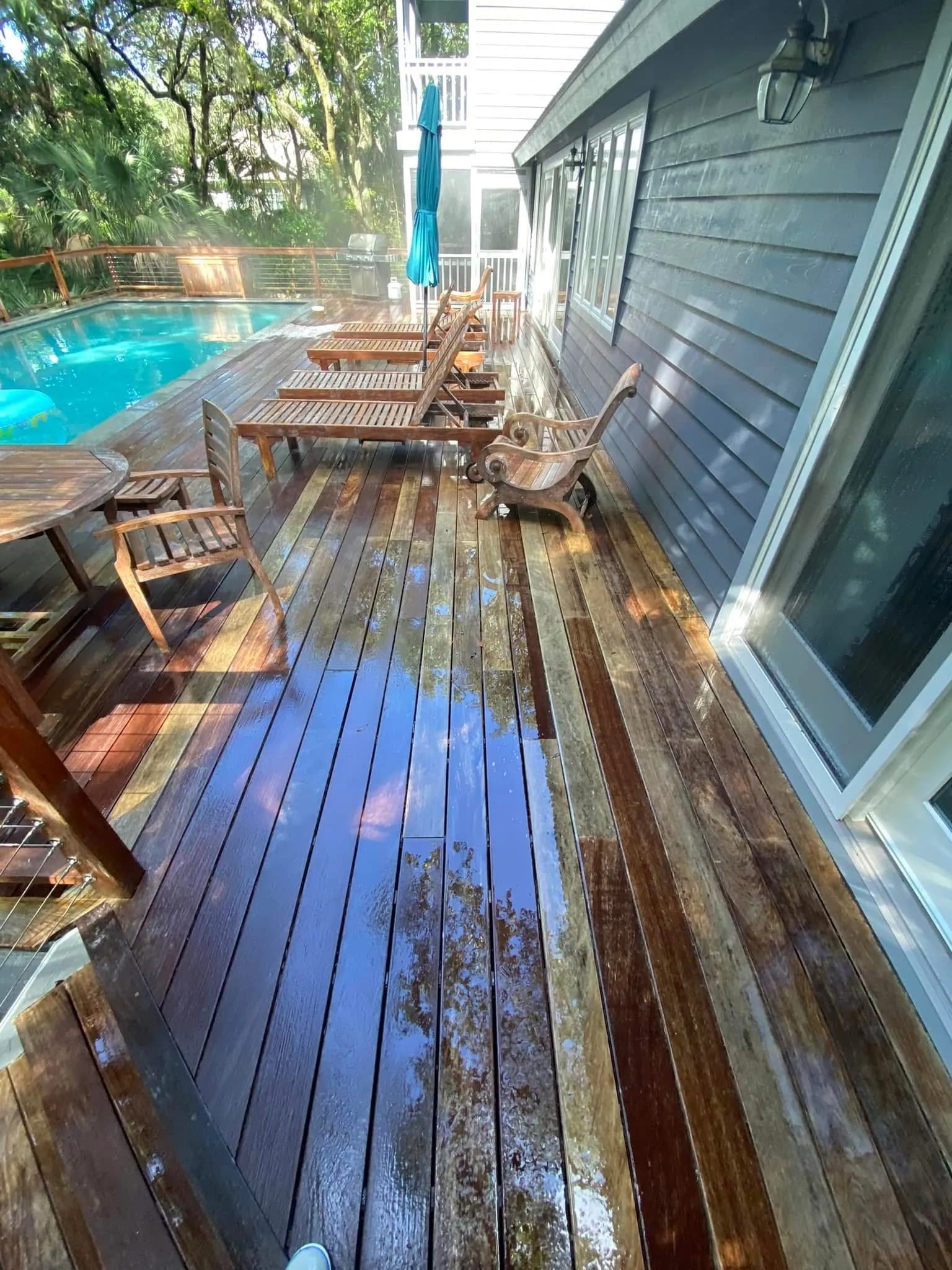
If your IPE deck has gone silver-gray, the wood itself is structurally fine. IPE has a 75-year structural lifespan in the Lowcountry climate; the gray is purely a surface UV-weathering effect. What's happening is that ultraviolet light is breaking down the lignin in the topmost 1/64 inch of the wood fibers, while salt air strips out the natural oils that gave the surface its rich brown color. The lignin breakdown is reversible. We use a two-stage oxygenated cleaner-plus-brightener system that lifts the dead surface fibers, neutralizes the UV oxidation, and exposes the still-rich brown wood underneath. After the cleaning the deck looks visibly five years younger.
We service this restoration most often on Kiawah Island, Sullivan's Island, and Isle of Palms: beachfront homes where salt-driven graying happens within a year of installation. Inland decks on Daniel Island and Mount Pleasant gray more slowly but follow the same restoration process when they do.
Reapplication interval in Charleston: every 12 to 18 months for inland decks, every 9 to 12 months for oceanfront homes. We track each client's last oil date and proactively reach out when the next application is due. Cleaning + oil bundled is significantly cheaper than cleaning followed by a separate oil visit because the mobilization is shared.
What Does IPE Deck Cleaning Cost in Charleston?
IPE deck cleaning in the Charleston area typically runs $800 to $3,000+ depending on three variables: square footage, gray-out severity, and whether the deck has been previously damaged by wrong-method cleaning. A small (under 400 sqft) inland IPE deck in Mount Pleasant that's been maintained on schedule runs $800 to $1,200 for cleaning + brightener. A 1,000 sqft Kiawah oceanfront deck that hasn't been touched in three years and has gone fully gray runs $1,800 to $2,800 for cleaning + brightener. Larger custom decks with multiple levels, pergolas, and railings on Sullivan's or Seabrook can run $3,000 to $5,000+ for a full restoration cycle.
Bundling with concrete cleaning on the same visit (pool decks, patios, walkways adjacent to the IPE) saves the separate mobilization fee, which on a Kiawah or Seabrook gated property runs $150 to $250 by itself. Most clients move to a maintenance schedule after the first restoration: annual cleaning for inland decks, and for oceanfront, an annual cleaning with a check in between.
Service Areas and Scheduling
We service IPE and exotic hardwood decks across the entire Greater Charleston area. The highest concentration of IPE work is in the luxury coastal markets (Kiawah, Sullivan's Island, Isle of Palms, Seabrook Island, and the premium Mount Pleasant neighborhoods of Old Village and I'On), but we also handle planned-community new-construction IPE on Daniel Island, downtown South of Broad rooftop terraces, and a steady rotation of Folly Beach beachfront properties. New clients can typically be quoted from satellite imagery and a few photos within 24 hours, with first cleaning scheduled within the same week. Existing clients are on annual or biannual standing schedules with priority booking.
 BeforeAfterDrag to compare