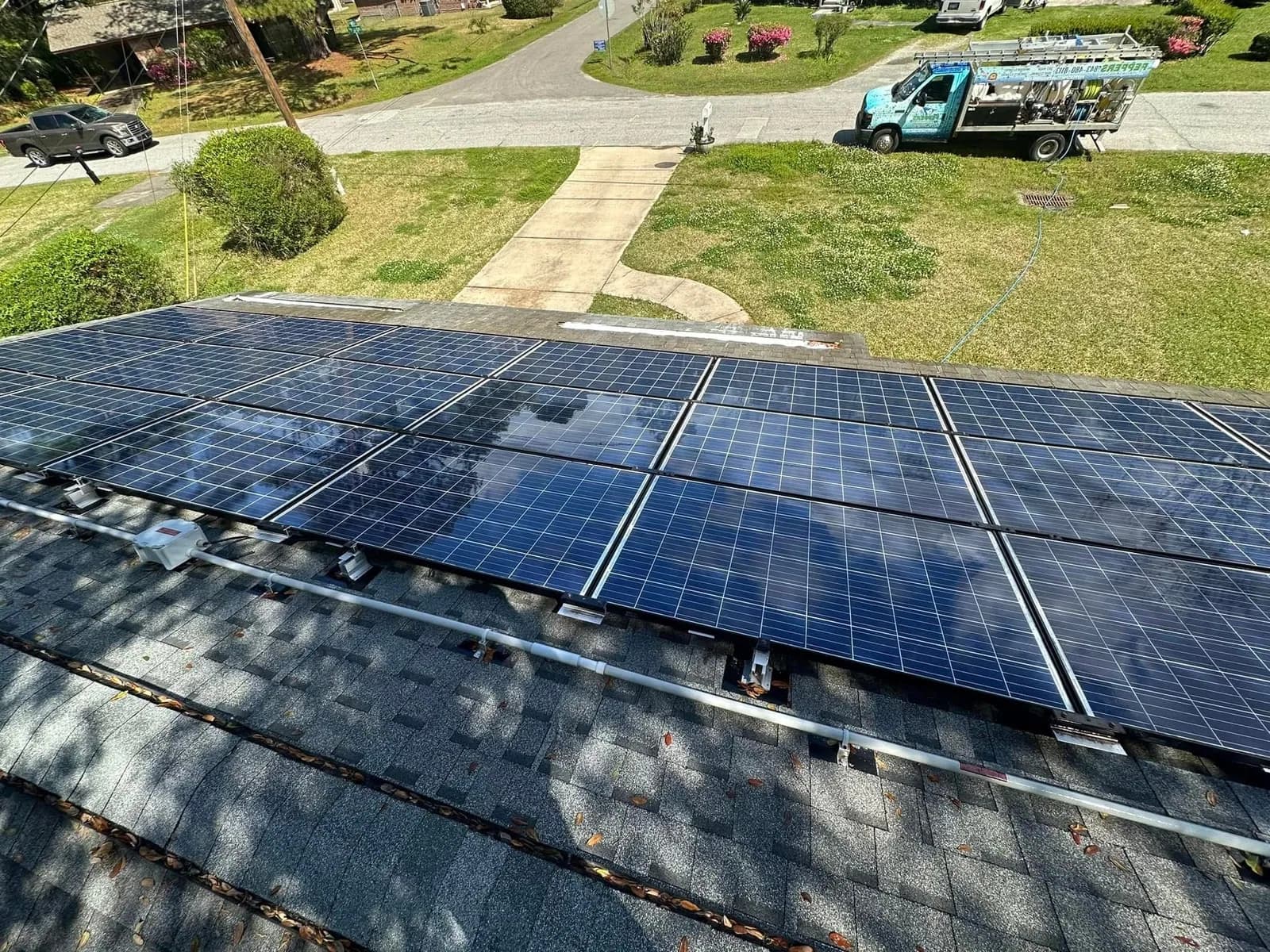
Solar panel cleaning is a different service from pressure washing or the high-pressure work we do on driveways and concrete. Photovoltaic panels are precision-engineered glass surfaces with anti-reflective coatings, tempered cell encapsulants, and aluminum frames that all behave very differently under cleaning force than vinyl siding or a sidewalk slab. The job calls for the same low-pressure, chemistry-driven technique we use on shingle roofs, and crews trained to recognize when a panel needs a hand-wipe versus a rinse, and when an aluminum frame is showing salt-corrosion damage that the homeowner needs to know about.
Charleston solar adoption has grown sharply over the last five years, with high-end arrays installed across Daniel Island, Kiawah Island, Mount Pleasant, and the newer West Ashley subdivisions. Most installations are 18 to 32 panels mounted on the south or southwest roof faces, exactly where pollen, salt haze, and bird activity hit hardest. Owners typically discover the efficiency loss first through their inverter monitoring app: kilowatt-hour output flat-lining or trending down across April and May despite peak sunlight months.
Why Is Pressure Washing Solar Panels Never the Right Answer?
High-pressure water (anywhere from 1,500 to 4,000 PSI on a typical pressure washer) does four things to a solar panel that you cannot recover from. First, it erodes the anti-reflective coating that the manufacturer applied to maximize light absorption; once that coating is scratched or stripped, output drops permanently. Second, it forces water past the silicone seals at the junction box and the panel-to-frame edges, where it eventually shorts the cells. Third, the thermal shock of cold water on a panel sitting at 140 degrees in summer sun can crack the cell encapsulant. Fourth (and this is the one most homeowners learn the hard way), every major solar panel manufacturer voids the warranty when the panel has been cleaned with high-pressure equipment.
The correct method is the same chemistry-driven, low-pressure approach we use on shingle roofs: deionized water (so no mineral residue dries on the glass), pH-neutral soap only when needed for heavy soiling, soft-bristle hand tools where pre-soaked bird droppings need removal, and a final rinse pressure that never exceeds garden-hose levels. Total time on a 24-panel residential array is typically 90 minutes to 2 hours, including frame inspection.
How Often Should You Clean Solar Panels in the Lowcountry?
Twice a year is the baseline for Charleston-area solar arrays. The high-priority cleaning is late May or early June, immediately after the live oak pollen season ends and before peak summer irradiance. Skipping this clean costs you the most output of any single decision because the highest-production months of the year (June, July, August) run on dirty panels. A second cleaning in October catches summer dust and bird activity before winter rains, which in Charleston are typically too brief and too humidity-laden to actually rinse panels effectively.
Three exceptions warrant more frequent cleaning. Oceanfront homes within five miles of the coast (Sullivan's Island, Isle of Palms, Folly Beach, Kiawah, Seabrook) should plan on quarterly cleaning because of constant salt deposition. Heavily shaded arrays under live oak canopy in Johns Island or Old Mount Pleasant collect more sap and bird droppings and benefit from a third clean in late summer. And any commercial or HOA-mandated array typically operates on a contract schedule documented for facility records.
How Much Does Solar Panel Cleaning Cost in Charleston?
Solar panel cleaning in the Charleston area typically runs $150 to $350 for a standard residential array. The two biggest variables are panel count and roof access: a flat single-story commercial roof with 30 panels runs less per panel than a steep-pitch residential install with 18 panels at three stories. Per-panel pricing typically falls between $8 and $15. Coastal premium applies for properties within five miles of the coast where salt-deposition cleaning is more involved. Bundling with roof soft washing or gutter cleaning on the same visit saves the separate roof-access mobilization fee.
The ROI math is straightforward. A typical Charleston residential solar array generates $1,500 to $2,200 per year in offset electricity costs at peak efficiency. Pollen and salt soiling that drops output 20 percent represents $300 to $440 in annual losses. A $250 cleaning pays for itself within the same year and restores measurable output within 48 hours. For commercial or HOA installations the math is even better: a 100kW array losing 20 percent output represents thousands of dollars in annual losses, which a single quarterly cleaning recovers immediately.
Service Areas and Scheduling
We service residential and commercial solar arrays across the entire Greater Charleston area, from Kiawah and Seabrook in the south up through Mount Pleasant, Sullivan's Island, Isle of Palms, Daniel Island, downtown Charleston, James Island, West Ashley, and out to Summerville. For new clients we can typically quote from satellite imagery within 24 hours and schedule the first cleaning within the same week. For ongoing maintenance, most clients move to either an annual or semi-annual visit on a recurring schedule, with priority booking ahead of pollen season every spring. Many of our solar clients bundle skylight cleaning into the same rooftop visit. Both services share the same access setup, same soft-wash chemistry, and the same April-pollen and October-pre-storm timing.
 BeforeAfterDrag to compare