Why Charleston Siding Gets Covered in Mildew Every June (And What Actually Works)
Mildew on siding in Charleston shows up every June like clockwork. You're driving down Pitt Street or parked at your Wagener Terrace bungalow and suddenly the north wall looks fuzzy and green. That's Gloeocapsa magma and algae feeding on moisture that never fully dries between our oak canopy and the marsh breeze.
Read more about our roof soft washing service.
The Lowcountry Mildew Recipe: Heat, Humidity, and Algae Spores
Charleston averages 78% relative humidity from June through September (NOAA). That's the highest sustained humidity in South Carolina. But the real problem isn't the humidity reading at noon; it's the dew point at 3 a.m.
Dew points above 70°F mean surfaces stay wet overnight. Your siding doesn't dry between sunset and sunrise. Mildew doesn't need rain to grow when the air itself condenses into a film every night from mid-June through mid-September (NOAA). I've pressure washed homes in July that show new streaks by October. The algae spores never left; they just waited for the next wet night.
June hits harder than August even though August runs hotter. Why? Spartina pollen. The marsh grasses release their heaviest pollen loads in late May and early June. That yellow-green dust settles on every horizontal surface, mixes with the dew, and creates a biofilm. Algae spores love biofilm. By the time August arrives, the algae colonies are already established and feeding on whatever the humidity provides.
Properties along the marsh edge get the worst combination: salt haze from the harbor plus biological growth from spartina-fed humidity. I've seen James Island houses near the water need soft washing every eight months instead of the twelve-month interval that works inland. The closer you are to standing water, the shorter your clean window.
Why North Walls and Overhang Areas Turn Green First
Direct sunlight kills mildew. Not immediately, but UV exposure over six to eight hours per day keeps most algae colonies from establishing. Your north-facing walls get maybe two hours of direct sun in summer and zero in winter. They stay damp.
I see the same pattern on every house from West Ashley to Mount Pleasant. The north wall shows streaks first. The covered front porch follows. Then the east wall if there's enough oak canopy overhead. South and west walls stay cleanest because the afternoon sun bakes off the overnight dew before algae can feed.
Oak canopy compounds the problem. Charleston's live oaks create permanent shade zones that never dry. I've soft washed James Island homes where the north wall under an oak stays green year-round while the south wall in full sun goes twenty months between cleanings. Same siding, same paint, opposite light exposure.
Covered porches act like petri dishes. No rain hits them directly, but humidity settles there every night. The ceiling traps moisture against the siding. By July, you'll see black streaks radiating from the porch overhang onto the siding below. That's mildew following the water trail.
What Doesn't Work: Garden Hose, Bleach Sprayers, and Home Depot Solutions
Most homeowners try three things before they call us. First: the garden hose with a spray nozzle cranked to "jet." You're getting maybe 100 PSI at the tip. That's enough to knock loose surface dirt but nowhere near enough to dislodge embedded mildew colonies. What actually happens is you spread the spores across a wider area while the root systems stay locked in the siding pores. Two weeks later the green comes back darker than before.
Second attempt: the pump sprayer from Home Depot filled with straight bleach or some "mold remover" that's mostly sodium hypochlorite. I see the aftermath on James Island and West Ashley houses all the time. Burned azaleas along the foundation, brown streaks down the siding where the bleach ran too concentrated, and the mildew still visible under the chemical stains. Straight bleach at 6% concentration will absolutely burn plant tissue and oxidize paint, but it won't penetrate deep enough into porous surfaces to kill the root structure. You're bleaching the surface layer while the mildew keeps growing underneath.
The third move is renting a pressure washer. Usually 2,500 to 3,000 PSI from a big-box store. That's enough power to strip paint, gouge wood siding, drive water behind the vapor barrier, and shatter window seals if you're not careful. I've quoted repairs for homeowners who took a 3,000 PSI tip to their Hardie siding and blasted through the finish coat. The mildew came off, sure. So did the paint and part of the substrate.
None of these methods address the actual problem, which is biological. Mildew and algae aren't dirt. You can't just rinse them away or bleach the surface. You need the right surfactant mix at the right dwell time to break down the root systems without damaging the substrate or the landscaping. That's what soft washing does. Low pressure (under 500 PSI), correct chemistry, controlled application.
Soft Washing vs Pressure Washing: PSI Numbers That Actually Matter
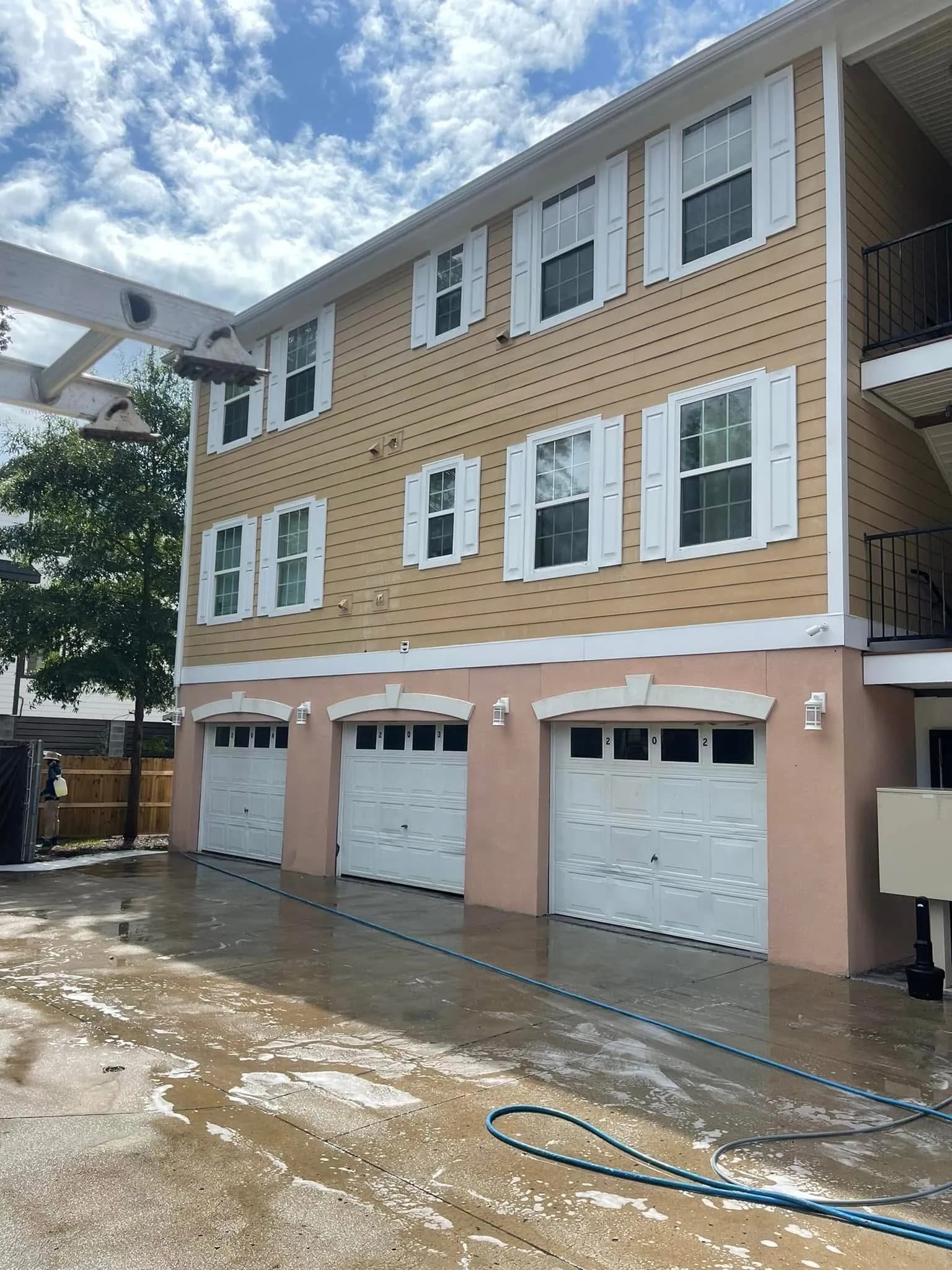
Soft washing runs at 500 PSI or less. That's garden-hose pressure with surfactant chemistry doing the actual work. The pump exists to apply the solution evenly, not to blast anything off. Pressure washing starts around 2,000 PSI and goes up from there. On Hardie board or vinyl siding, that's enough force to drive water behind the panels, crack caulk joints, and push moisture into wall cavities where it stays trapped.
I've soft washed fiber cement siding on James Island houses that still look clean eighteen months later. Same surfactant mix on vinyl in Mount Pleasant. The chemistry kills mildew at the root level, so it doesn't grow back in six weeks when the humidity climbs. Pressure washing removes the visible layer but leaves the root structure alive in the pores of the substrate. Charleston averages 78% relative humidity from June through September (NOAA), which means those surfaces stay damp enough overnight to support continuous regrowth. You're looking at 90 days before the green comes back.
The real difference shows up on trim and caulk lines. A 2,500 PSI tip held six inches from a window can crack the seal or drive water into the frame. Soft washing at 300 PSI won't. You can work close to painted wood, around light fixtures, near HVAC line sets without risking damage. The surfactant does what the pressure can't: it breaks down organic growth chemically instead of mechanically tearing it off along with whatever's underneath.
How Long a Professional Soft Wash Keeps Mildew Off Charleston Siding
A properly executed soft wash on James Island or Mount Pleasant siding stays clean eighteen to twenty-four months. That assumes we applied the surfactant at the correct dilution, allowed ten minutes of dwell time, and rinsed thoroughly enough that no residue attracts dirt later. 'Done correctly' means the chemistry killed the mildew root structure in the substrate pores, not just the visible layer on the surface.
Companies that promise three years are either lying or they're talking about houses in Arizona. Charleston dew points average above 70°F from mid-June through mid-September (NOAA). Surfaces stay wet enough overnight to support continuous mildew growth. No surfactant on earth stops that forever. The chemistry buys you time by eliminating the existing colonies; humidity and oak pollen bring new spores within weeks. The question is whether those spores find a clean substrate or one still colonized from the last growth cycle.
The companies delivering eight months instead of eighteen are cutting corners somewhere. Usually it's dwell time. They spray and rinse in five minutes because the crew has six more houses that day. The surfactant never penetrates deep enough to kill the root structure. Sometimes it's dilution: they're running 0.25% sodium hypochlorite instead of 0.5% to save on chemical cost. That knocks visible mildew off but leaves enough alive in the pores that regrowth starts in twelve weeks instead of twelve months.
James Island properties along the marsh edge get the worst of both worlds: salt haze from the harbor and biological growth from the spartina-fed humidity. We've shortened the interval to eight or ten months on a few Cassique homes where the house sits twenty feet from standing water. That's not a service failure. That's just physics.
Timing Your Wash: May Before It Blooms or July After the Damage
We soft wash most Kiawah homes in late May. The mildew has started showing up on north-facing trim and under the eaves, but the June algae bloom hasn't hit yet. That timing gives you fourteen to sixteen clean months before the next service. Wait until mid-July and you're cleaning after Charleston's heaviest rain months have already fed two full growth cycles (NOAA). The mildew has eaten into the paint substrate by then. You'll still get it clean, but the next regrowth starts faster because the root structure dug deeper.
Downtown homes on a tight maintenance schedule can push into early June without much penalty. The brick and stucco south of Broad don't hold moisture the same way vinyl siding does. But if you're on James Island near the marsh, May is the hard cutoff. Those properties see salt haze and spartina humidity at the same time. We've logged August service calls where the homeowner waited past July and the mildew had already stained the fascia boards through two layers of paint.
The cost difference isn't in the wash itself. It's in how often you're paying for it. A May wash on a typical Mount Pleasant home buys you until next summer. A July wash might only hold until next April, which means you're back on the schedule six months early and paying an extra cycle every two years.
Frequently asked questions
Can I just spray store-bought bleach on my siding?
You can, but straight bleach kills foundation plants and only whitens surface mildew without killing the roots in siding pores. You'll see green streaks again in four to six weeks.
Will pressure washing crack my Hardie board siding?
High pressure (anything over 1500 PSI) can crack caulk lines and force water behind fiber cement boards. Soft washing at 300 to 500 PSI with surfactants avoids that risk completely.
Why does the north side of my house always turn green first?
No direct sun. Mildew dies in UV light but thrives in damp shade, especially under live oak canopies or wide eaves where marsh breeze keeps moisture sitting on siding.
How long will a soft wash actually keep my house clean in Charleston?
Eighteen to twenty-four months if the contractor pre-treats with surfactant and uses the right bleach dilution. Homes in deep shade near Shem Creek or Folly marshes sometimes need it annually.
Is it too late to soft wash in July, or should I wait until fall?
July works fine. May is smarter if you want to prevent the June bloom, but waiting until fall just means you're staring at green siding for three more months.
Want a quote on your roof soft washing? Get a free estimate.