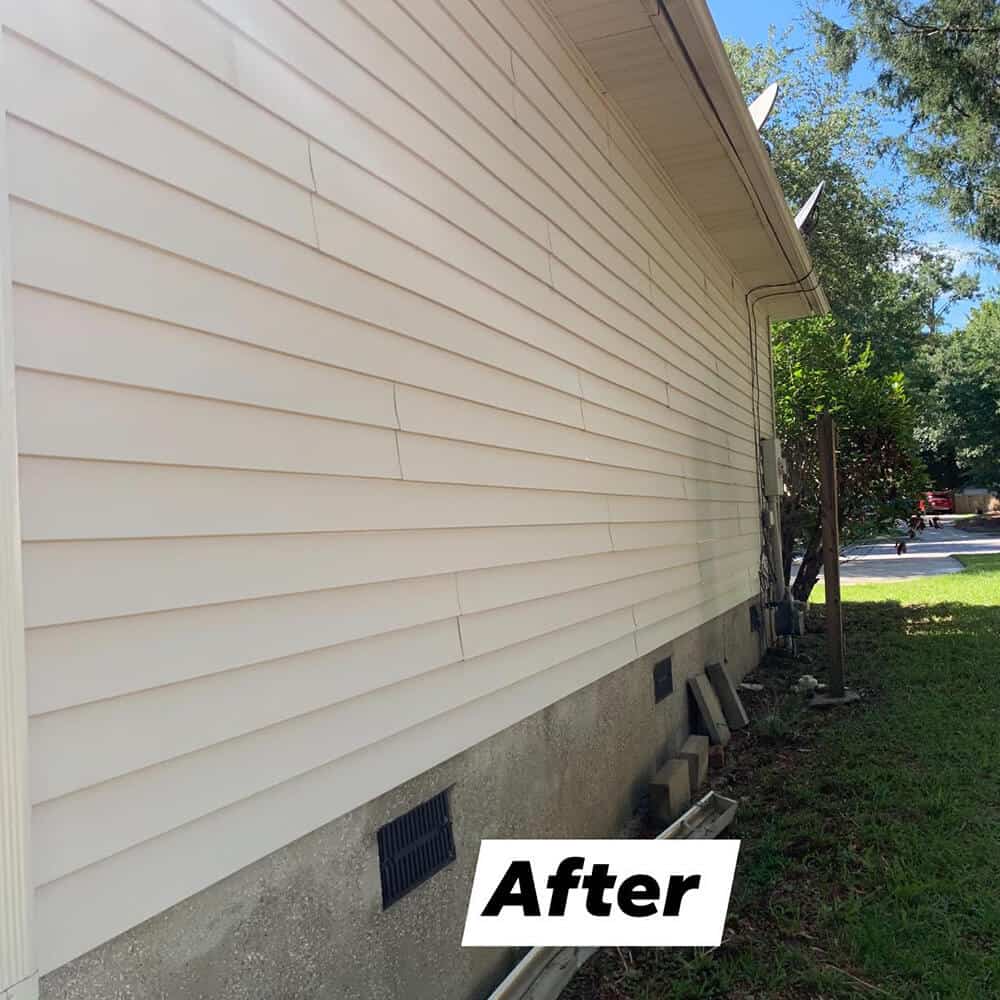
If you are picking between soft washing and pressure washing for your Charleston home, the short answer is almost always the same: soft wash the siding, pressure wash the hardscapes. That is not a marketing line. It is what the manufacturers of vinyl siding, fiber cement (Hardie), stucco, and painted wood trim actually tell you in their warranty documents. Below we break down what each method really means, why high-pressure water is the wrong tool for the vertical surfaces of your home, and what a proper soft wash house wash looks like in the Lowcountry.
The short answer: soft wash siding, pressure wash hardscapes
Almost every reputable exterior cleaner in Charleston treats a home in two zones. Vertical surfaces (vinyl, Hardie, stucco, painted wood, brick walls) get soft washed with low pressure and a cleaning solution that kills mildew and algae at the root. Horizontal hardscape (driveways, walkways, pool decks, patios, concrete pads) gets pressure washed with a surface cleaner. If a company shows up and immediately aims a pressure washing wand at your siding, that is the moment to stop them. The methods are not interchangeable, and using the wrong one is where damage comes from.
What soft washing actually is
Soft washing is low-pressure application of a biodegradable cleaning solution that kills the organic growth (algae, mildew, lichen, black mold) that makes a Charleston home look dirty in the first place. The pressure coming out of the nozzle is usually around 60 to 100 PSI, which is roughly the same as a garden hose. The cleaning happens chemically, not mechanically. Dwell time, rinse, done.
A typical Charleston soft wash mix includes:
A diluted surfactant-based cleaner that breaks up surface grime and pollen
A measured dose of sodium hypochlorite (the active ingredient in common household bleach, highly diluted) to kill algae and mold spores at the root
A clinging agent so the solution stays on vertical siding long enough to work
A thorough rinse with filtered water, not high pressure
This is the same method used by our roof soft washing crew on shingle roofs, and it is the correct method for siding too. If you want the deeper chemistry, our post on soft wash vs pressure wash for roofs covers the same principles applied to roof surfaces.
What pressure washing is, and when it is the right call
Pressure washing uses water pressure alone (typically 2,500 to 4,000 PSI) to mechanically blast grime off a surface. On the right surface, it is incredibly effective. On the wrong surface, it is destructive. Use pressure washing for:
Concrete driveways and sidewalks (surface cleaner attachment, not a narrow wand)
Pool decks, paver patios, and stamped concrete
Brick and stone walkways (at reduced pressure)
Parking lots, commercial drive lanes, and loading docks
Fence rails and decks (with calibrated tips, see our deck cleaning guide)
Our concrete cleaning service uses a dedicated surface cleaner attachment for driveways. It spins two nozzles under a shrouded disc at around 3,000 PSI, producing even, streak-free results. That is the right use of pressure washing. Aiming that same wand at your siding is not.
Why pressure washing siding is a bad idea, especially in Charleston
Vinyl siding, Hardie plank, stucco, and painted wood are not designed to handle 3,000 PSI of direct water. Here is what actually happens when a company pressure washes your siding:
Water gets driven behind the panels through the overlap joints. On vinyl siding, this creates a perfect breeding environment for mold inside the wall cavity: the exact problem you were trying to solve, now hidden behind the siding.
Paint gets stripped from wood trim, soffits, and window frames. Once paint lifts, you have exposed wood that will rot in Charleston humidity within a season or two.
Stucco surface gets etched. Stucco is porous and relatively soft; high-pressure water tears the top layer off and leaves a rough, uneven texture that holds dirt worse than before.
Window seals get compromised. Direct high-pressure spray near window frames can force water past the gaskets, leading to interior leaks weeks or months later.
The mildew comes back in weeks. Pressure alone removes what is on the surface, but does not kill the spores. In our climate, algae regrows within a month, sometimes worse than before because the surface is now scarred and holds moisture longer.
Charleston makes all five of these problems worse. Salt air from the barrier islands drives moisture into siding seams. Oak canopy keeps homes damp between rainfalls. Our humidity averages 75 percent year-round. The last thing your exterior needs is more water forced into places it does not belong.

How to tell what your siding needs by material
The siding material on your home determines the exact soft wash approach, but in every case the answer is soft wash, not pressure wash:
Vinyl siding: soft wash with diluted sodium hypochlorite solution. The green and black streaks on white vinyl in Charleston are algae, not dirt, and they will come off chemically in minutes. See our full guide on black mold on vinyl siding.
Fiber cement (Hardie): soft wash only. James Hardie explicitly voids warranty coverage on damage caused by pressure washing. The cement fibers are durable but the painted surface is not.
Painted wood clapboard (common on downtown Charleston historic homes): soft wash at very low pressure, often hand scrubbed on trim. Paint is the primary concern here.
Stucco: soft wash with an adjusted mix that will not etch the surface. Never pressure wash stucco.
Brick: soft wash first; spot pressure wash only if mortar is in good condition. See our post on brick cleaning on Charleston historic homes.
What a proper soft wash house wash should cost in Charleston
Charleston-area pricing in 2026 typically runs:
Single-story home under 2,000 sqft: $289 to $449 for a full soft wash house wash
Two-story home 2,000 to 3,500 sqft: $449 to $749 depending on access, roof pitch, and vegetation around the home
Three-story or luxury coastal home (Kiawah, Sullivan's Island, Isle of Palms): $749 to $1,499+ depending on square footage, height, and accessories cleaned
Prices vary by neighborhood: Mount Pleasant, Daniel Island, and James Island each have different access and vegetation profiles. Request a free quote with your address and we will give you an exact number within 24 hours, not a range.
Five questions to ask before anyone cleans your siding
Before you let a company near your home with a wand, ask these:
Do you soft wash siding, or pressure wash siding? (Right answer: soft wash.)
What PSI do you use on vinyl, Hardie, or stucco? (Right answer: under 500 PSI on the final rinse, and cleaning is chemistry-driven.)
Are you insured and licensed in South Carolina? (Ask for the certificate, not a promise.)
Will you protect landscaping, downspouts, and outdoor furniture before you spray? (Right answer: yes, plants get pre-wet and rinsed; furniture gets moved or covered.)
What is your warranty on the result? (Right answer: some form of no-streaks guarantee or free re-service if mildew returns within a set window.)
The Peppers approach to house washing
Every Peppers job on siding is a soft wash. We carry calibrated soft wash systems (not modified pressure washers) and our crews are trained on the specific quirks of Charleston exterior materials. Our pressure washing service page and roof soft washing page spell out exactly what is included at each price tier. You can also browse our before-and-after gallery to see the results on homes in your neighborhood, or read verified reviews from Charleston homeowners.
If you are not sure which method your home needs, start with our free property assessment tool: enter your address and we will analyze your roof, siding, and hardscape surfaces from satellite, then tell you exactly what is worth cleaning and what can wait another season. No pressure (pun intended), no callbacks required.