Post-Hurricane Pressure Washing in Charleston: What to Clean First (and What to Wait On)
After hurricane cleanup in Charleston, most people grab a pressure washer and start blasting everything the day the roads reopen. That's how you drive pluff mud into Hardie siding, seal algae under deck stain, or spray contaminated marsh water straight through your foundation vents. We've cleaned up behind four hurricanes now, and the order matters more than the speed.
Wait 48-72 Hours Before You Touch a Pressure Washer
I know you want to start cleaning. You've got sand in your screened porch and salt crust on your windows. But give it three days.
After Hurricane Helene came through last September with 60-70 mph winds (National Weather Service Charleston), we had homeowners calling us the next morning. I turned down every job for 72 hours. Not because I didn't want the work. Because pooled water hides downed lines, debris shifts when you spray it, and mold spores are still active in that wet organic layer stuck to your siding.
During the waiting period: document everything with photos, clear gutters by hand if you can reach them safely, and let your insurance adjuster see the mess before you touch it. Rake the obvious stuff away from your foundation. Don't hose anything yet.
This saves you money because cleaning wet organic matter just spreads it. You'll wash it today, then need to wash again in two weeks when the mildew blooms. We've seen it dozens of times on Mount Pleasant jobs after heavy rain. Let the surface dry enough that the grime has separated from the substrate. Then one pass does the job.
If you've got standing water against your house three days after landfall, you've got a drainage problem that pressure washing won't fix.
Storm Debris vs. Organic Staining: Sorting What Actually Needs Pressure
Most of what's on your siding after a hurricane is wind-blown mud. It rinses off with a garden hose at 60 PSI. You don't need me.
What looks like dirt but won't budge with water is usually tannin staining. Oak debris and magnolia leaves break down into brown residue that bonds to painted surfaces. That needs a chemical surfactant (we use a dilute sodium hypochlorite mix), dwell time, then a low-pressure rinse at 1,200 PSI. No scrubbing.
Actual mildew colonization is the third thing. It shows up as black or green patches, not uniform brown. You'll see it in shaded corners where wet organic matter sat for three or four days. This requires both chemical treatment and pressure to lift the root structure out of porous surfaces like stucco or wood grain.
I've had Mount Pleasant homeowners pay $400 for a whole-house wash when all they needed was a $40 bottle of deck cleaner and a weekend. I've also seen people scrub tannin stains for two hours with a brush before calling us. If it doesn't rinse in five minutes, you need chemistry or you need pressure. Sometimes both. Never just elbow grease.
The Clean-From-Top-Down Rule (and Why Storm Surge Changes It)
On a normal service call we start at the roof line and work down. Gravity is your friend. Rinse from the gutters, then the siding, then the driveway. This keeps you from re-contaminating surfaces you already cleaned.
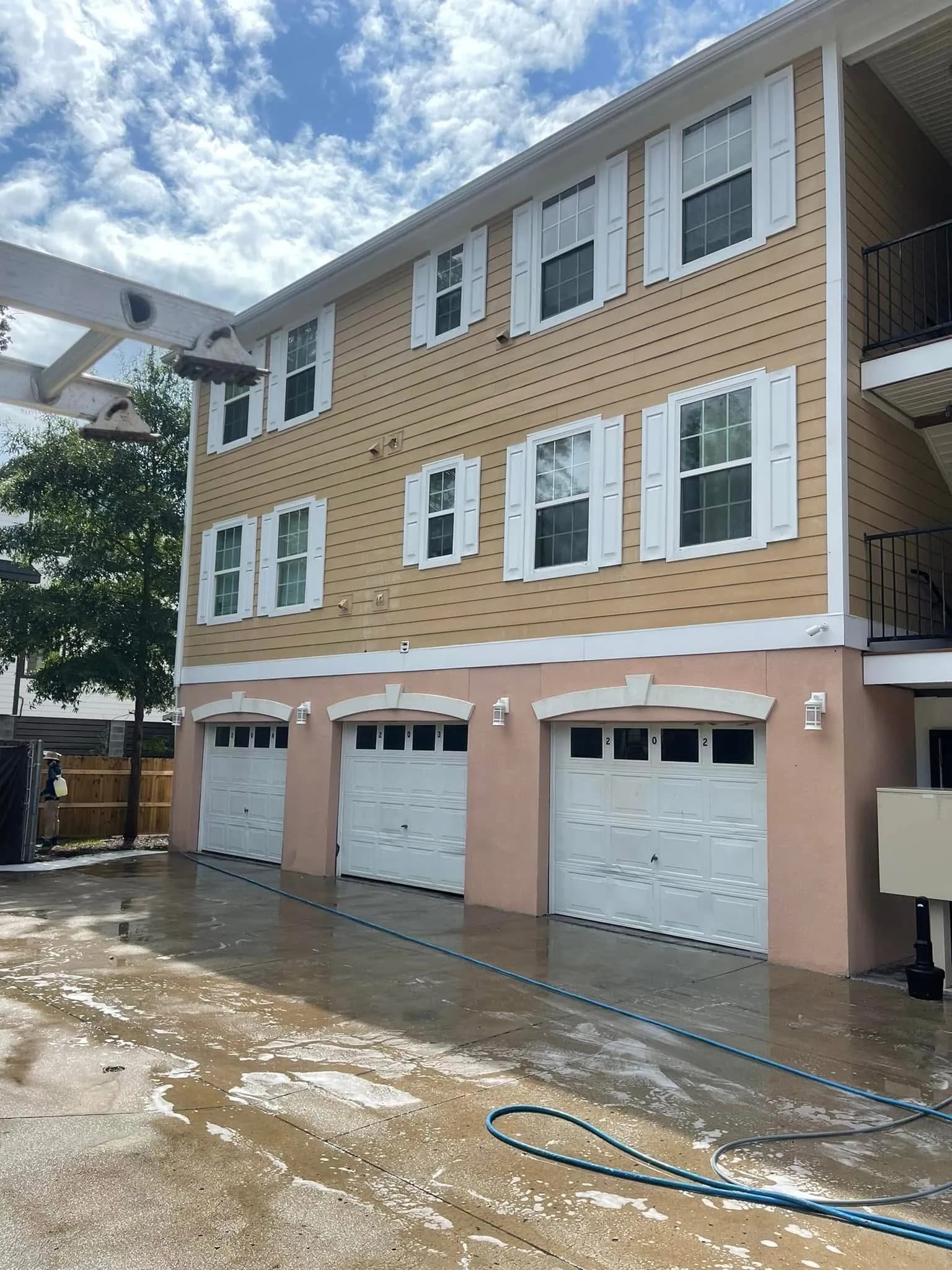
After storm surge, that sequence flips. If floodwater sat in your crawlspace or came through your first floor, the lower eight feet of your house is contaminated with brackish water, pluff mud, and whatever was in the street. That needs to be addressed first. You're not cleaning aesthetics anymore; you're removing biological hazards and salt that will corrode metal fixtures in thirty days.
I saw this after Matthew in 2016. Downtown properties south of Broad took nine feet of tidal surge at the Battery (NOAA). Homeowners wanted their brick cleaned. We started with foundation vents, then the hardscapes, then the first-floor siding. Only after that did we move to the upper stories. If you wash the roof first, all that organic load runs down and redeposits on the very surfaces that had standing sewage three days earlier.
James Island is different. Most homes there sit high enough to avoid surge but low enough to get yard flooding. We'll still start top-down because the contamination is limited to landscaping and the lower two feet of siding. Compare that to the Old Village in Mount Pleasant, where harbor-side properties flood from below. Those get the reversed sequence every time: hardscape, crawlspace access, lower siding, then standard top-down from there.
If you're not sure whether you took surge or just wind-driven rain, look at your air conditioning condenser. If there's a mud line above the concrete pad, you flooded. Reverse the order.
Addressing Pluff Mud, Saltwater Residue, and Marsh Grass on Siding
Storm surge is not rainwater. It carries salt, pluff mud, Spartina grass, and organic matter from tidal creeks that behave completely differently than the pollen and mildew we clean every spring. Salt crystallizes in the texture of Hardie siding and vinyl soffit. It holds moisture against the surface and accelerates rust on nail heads, window trim, and electrical boxes. If you don't neutralize it within two weeks, you'll see corrosion that wasn't there before the storm.
We start with a low-pressure freshwater rinse. 800 PSI, no chemical yet. to knock off the dried mud and grass blades stuck to the siding. Spartina is fibrous. It wraps around trim boards and window sills like twine, and it doesn't come off with soap alone. You have to physically flush it. I've seen crews skip this step and go straight to bleach; they end up with clean siding and a bunch of dried grass cemented in place by the surfactant. That's cosmetic neglect, and it traps moisture behind the blades.
Once the debris is off, we hit the salt haze with a 0.5% to 1% sodium hypochlorite mix (that's household bleach diluted 50:1 or 25:1 depending on the haze thickness). Salt itself doesn't react to bleach, but the biofilm and organic residue that came with it does. The surfactant in the mix helps break the salt's bond with the siding so the final rinse can carry it away. On harbor-facing properties in the Old Village or along Shem Creek, we'll do a second rinse with deionized water if the homeowner wants every trace of salt gone. Most don't need it unless they're prepping for paint.
The reason we separate pluff mud from regular dirt is simple: pluff mud is anaerobic. It smells like sulfur when it dries, and it stains lighter siding with an iron oxide tint that regular bleach won't fully remove. If your home took surge and you're seeing orange or rust-brown streaks two weeks later, that's pluff staining. It requires an oxalic acid follow-up, not more pressure. We've done this on twenty James Island properties since Matthew. It works.
What Insurance Will (and Won't) Cover for Post-Storm Cleaning
Most homeowner policies cover structural cleaning if storm surge or wind-driven rain caused interior damage. That means drywall, flooring, insulation. The adjuster wants to see water intrusion, not just dirt. If your roof leaked and stained the ceiling or your windows failed and soaked the carpet, that cleanup is usually covered under dwelling or personal property coverage.
Exterior cosmetic washing almost never qualifies. Siding covered in pluff mud or salt haze is considered routine maintenance, not storm damage. I've had three clients try to claim it after Matthew. All three were denied. The logic: your siding still functions. It's ugly, but it's not broken.
The exception is when the exterior contamination directly caused structural harm. If pluff mud clogged your soffit vents and moisture built up in the attic, or if salt residue corroded aluminum window frames to the point of failure, document it with photos before you clean anything. Show the adjuster the connection between the debris and the damage. We've had two claims approved this way, both on Folly Beach homes where sand abrasion pitted the frames so badly they couldn't seal.
If you're filing, take timestamped photos from four angles before you touch anything. Write down what you're seeing (salt crust, dried mud depth, staining). Get the cleaning estimate in writing with line items, even if you don't submit it. Most adjusters won't reimburse cosmetic work, but the documentation protects you if secondary damage shows up later.
When to Call a Pro vs. When a Garden Hose Is Enough
If you're in Wagener Terrace and got two inches of rain, you probably don't need us. Hose off the pollen and the oak petal residue. You're done. Same for a quick thunderstorm that left dusty streaks on your siding. Garden hose pressure (40-60 PSI) handles light surface dirt without any risk of forcing water behind trim or saturating wood.
If you're on Seabrook and had four feet of surge, DIY equipment won't touch it. The pluff mud and salt will reappear within two weeks unless you use surfactants and the right dilution ratios. Consumer pressure washers (1,200-1,800 PSI) also lack the flow rate to rinse thick deposits before they dry again. We run 3.5-4 GPM with heated water on concrete and 2 GPM cold on siding. The gallons matter more than the pressure.
Here's the line: if you can wipe a test patch with your hand and it comes off, try the hose. If it smears or if you see black streaks (algae, not dirt), you need surfactant and dwell time. If the debris is gritty or if you're seeing rust stains, sand abrasion, or dried salt crust thicker than a credit card, call someone with a proportioner and the right chems.
We're not here to upsell maintenance cleaning. But we are here when storm residue crosses into the zone where a homeowner's equipment can't reach or where you risk damaging finishes by guessing on pressure and angle. If you're not sure, text us a photo. We'll tell you if it's a hose job or if you need the truck.
Frequently asked questions
How long after a hurricane should I wait before pressure washing?
Wait 72 hours minimum. That gives standing water time to drain, debris to settle, and you time to walk the property for cracked stucco or loose siding that'll blow apart under even low pressure.
Will my homeowners insurance cover post-storm pressure washing?
Almost never. Insurance pays for cleaning only when it's part of repairing covered damage (like removing contaminants from flooded interior drywall). Exterior cosmetic work doesn't qualify.
Can I wash my house if there's still water pooling in the yard?
No. You'll churn up mud, risk shocking yourself if outlets are wet, and push contaminated runoff straight into your foundation or the neighbor's crawlspace.
Do I need higher PSI to remove storm dirt and salt?
No. Storm residue isn't harder than everyday mildew; it just covers more square footage. We still use 1500 PSI or less on vinyl and under 1200 on stucco.
Is exterior mold after a hurricane an emergency?
Exterior mildew on siding or fences can wait a week or two without causing real damage. Interior mold on drywall or in crawlspaces is urgent and needs a certified remediation crew, not a pressure washer.
Want a quote on your pressure washing? Get a free estimate.