Black Mold on Vinyl Siding: When DIY Stops and a Soft Wash Starts
Black mold on vinyl siding in Charleston usually isn't mold at all. It's algae, mildew, or artillery fungus spores from the mulch beds under your eaves, and all three love the six months of 80% humidity we get between May and October. You can scrub the surface streaks off with a brush and bleach water, but the stuff growing behind the siding seams won't budge without a proper soft wash.
Read more about our roof soft washing service.
What You're Actually Looking At (Spoiler: Probably Not Black Mold)
Most calls I get start with "we've got black mold on our siding." I show up and it's algae. Dark streaks that look alarming but won't make you sick.
Charleston siding collects three types of growth. Gloeocapsa magma is the most common (it's the cyanobacteria that feeds on limestone in your paint and shingles). Artillery fungus shows up as tiny black dots you can't scrub off without damaging the surface. Actual mildew is the fuzzy stuff that smells like wet towels and mostly appears in shaded corners near gutters.
Only one of those three matters for your health: mildew. The other two just make your house look like it's been sitting vacant for six months. But here's the thing. Charleston averages 78% relative humidity from June through September (NOAA). All three grow back fast unless you kill the root colony, not just blast the surface clean.
I've pressure washed James Island houses that looked perfect for eight weeks, then went black again by Labor Day. That's the humidity talking.
Why Vinyl Siding Gets Worse Faster Than Brick or Stucco
Vinyl has texture grooves. Every horizontal plank holds tiny ridges that trap moisture and spores. Brick and stucco dry fast. Vinyl doesn't.
The bigger issue is behind the surface. Your vinyl sits one to two inches off the sheathing, creating a humid pocket where air barely moves. Charleston dew points average above 70°F from mid-June through mid-September (NOAA). That pocket stays wet overnight. Growth starts there before you see surface stains.
North-facing walls turn black first. So do sections under oak canopy. Both stay shaded most of the day, and the magnolia sap doesn't help. I've cleaned James Island houses where the south side looked fine and the north side looked condemned. Same house, same day, completely different biology.
Brick breathes. Stucco dries. Vinyl traps.
The Three DIY Methods Homeowners Try (And Why Two Fail)
First method: garden hose with a brush attachment. You're basically wiping the surface with wet bristles. The black streaks laugh at you. Algae sits in the vinyl grooves where a brush can't reach, and you'll scrub for an hour just to lighten one wall section. I've never seen this work on James Island humidity.
Second method: pressure washer from Lowe's. This one actually removes the stains, which is why homeowners love it for about six weeks. Then the siding starts buckling near the seams. You blasted water behind the panels, soaked the sheathing, and voided your warranty. Most vinyl manufacturers specify maximum 1,500 PSI at a 45-degree angle. That rental unit runs 3,000 PSI, and nobody reads the manual.
Third method: bleach wipes or a pump sprayer with diluted bleach. This kills surface mildew if you let it dwell for ten minutes. Small spots near a gutter downspout? Fine. Whole north wall? You're wiping for three hours, and you still won't reach the seams where the root colony lives. The streaks come back in eight weeks because you only treated what you could see.
The honest answer: bleach wipes work for isolated spots smaller than a dinner plate. Anything larger needs a pump sprayer, surfactant to help the bleach stick, and enough dwell time to kill growth in the seam pockets. That's halfway to professional soft washing. If you're past the ten-foot section stage, you're into equipment territory.
How Soft Washing Removes Black Mold on Vinyl Siding Without Damage
We run between 100 and 300 PSI. That's garden-hose territory. The difference is the chemistry: sodium hypochlorite (pool-shock bleach) mixed with surfactants that make it cling to vertical surfaces instead of running straight down into your azaleas.
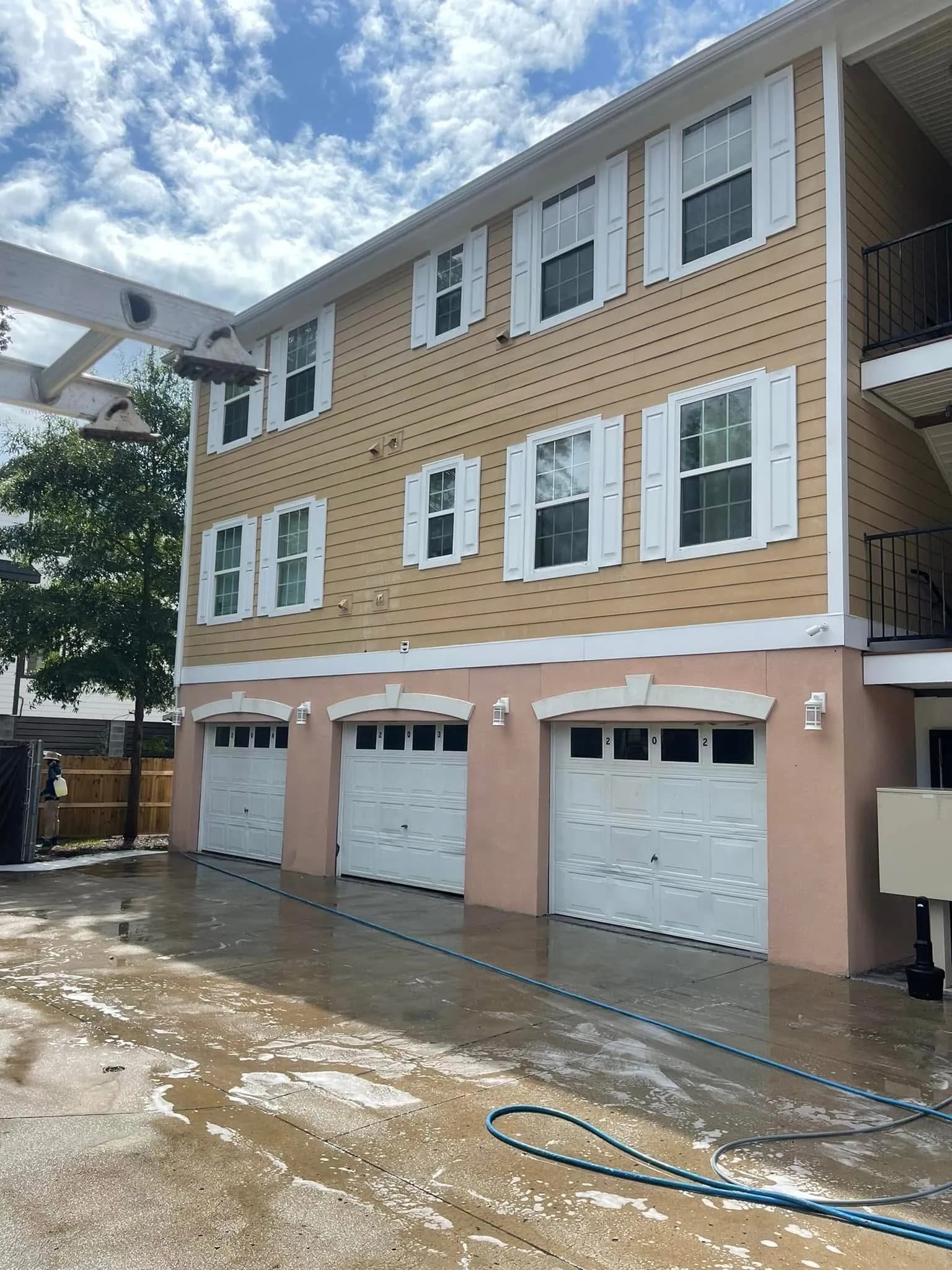
The solution goes on from bottom to top so drips don't streak through clean sections. We let it dwell ten to fifteen minutes. That's when the work happens. The sodium hypochlorite oxidizes the mildew's cell walls, kills the root colonies under seam edges, and lifts staining out of the texture grooves without mechanical scrubbing. You'll see the black streaks turn gray, then fade to nothing while the crew checks window seals.
The low pressure matters because vinyl panels interlock with a thin flap system. Blast 2,500 PSI at a seam and you're forcing water behind the panel, soaking the house wrap, sometimes reaching the OSB sheathing. Soft washing puts chemical contact on the surface without hydraulic force behind the seams. The rinse afterward runs maybe 200 PSI, just enough to carry away dead biofilm.
On James Island properties near the marsh, we often pre-wet the landscaping and rinse it again after the house. The saltwater-tolerant stuff (spartina, cordgrass) doesn't care. Your impatiens do. The surfactant also breaks down faster in sunlight than straight bleach, so we time jobs for mornings when the solution won't bake onto siding in 94-degree afternoon heat.
When to Call Instead of Climbing That Ladder Yourself
If the staining covers more than two full panels, reaches above your gutters, or shows up again six months after you scrubbed it, DIY stopped being cost-effective three rounds ago.
We see this pattern constantly on James Island properties near the marsh: homeowners clean the garage-side wall in March, it looks fine through April, then by June the black streaks are worse than before. Charleston averages 78% relative humidity from June through September (the highest sustained humidity in South Carolina), so surfaces stay damp enough overnight to feed continuous regrowth (NOAA). Scrubbing kills what you see. It doesn't kill the root colonies living in the texture grooves or under the seam flaps.
Whole-house soft washing runs between $400 and $800 depending on square footage and tree cover. Spot-treating two walls might save you $150 today, but you'll be back out there in four months while the untreated sides seed new growth across the clean sections. We usually recommend full treatment up front, then maintenance every twelve to eighteen months. Properties under heavy oak canopy in West Ashley sometimes need eight-month intervals. That's still cheaper than repainting.
What Happens If You Leave It (Besides Looking Bad)
Algae and mildew don't eat through vinyl the way they attack wood. But they hold moisture against whatever's behind your siding. That's where the damage starts. Your sheathing and OSB stay wet longer, the wood fibers break down faster, and rot moves in before you see any exterior warning signs.
Artillery fungus is worse. Those brown spore dots etch into the vinyl surface itself. If you catch them within a season, we can usually dissolve most of the staining. Wait two years and they're permanent. I've seen whole walls on James Island properties where the homeowner thought it was dirt, scrubbed twice, gave up, then called us when the spots wouldn't budge. At that point you're repainting or replacing panels.
Cleaning it early costs $400 to $800. Replacing rotted sheathing behind six panels costs closer to $3,200 once you factor in siding removal, framing repair, and reinstallation. The math works itself out pretty fast.
Frequently asked questions
Can I pressure wash vinyl siding myself without damaging it?
Stay under 1500 PSI and use a 25-degree tip at least 18 inches away. Anything higher or closer risks blowing water behind panels, which voids most siding warranties and creates interior mold problems you can't see.
How long does a soft wash treatment last on Charleston vinyl siding?
We see 18-24 months on sun-facing walls, 12-18 months under heavy oak canopy. Houses near marsh or Shem Creek regrow faster because salt haze and constant humidity feed algae.
Is the black streaking on my siding actually dangerous mold?
No. The black streaks are Gloeocapsa magma (a cyanobacteria) and surface mildew, neither of which are respiratory hazards outdoors. Toxic black mold (Stachybotrys) grows on wet drywall and wood inside walls, not on exterior vinyl.
Why doesn't straight bleach remove all the black stains?
Bleach kills surface growth but lacks surfactants to lift embedded stains or reach into seams. A proper mix (bleach plus detergent with a 10-15 minute dwell time) breaks the bond between algae and vinyl.
What's the difference between soft washing and pressure washing for black mold?
Soft washing uses 100-300 PSI and chemistry (surfactants, biocides) to kill and dissolve algae; pressure washing relies on 1500+ PSI water force to blast it off. Soft washing lasts longer and doesn't risk panel damage.
Want a quote on your roof soft washing? Get a free estimate.